



Above: BLM Group’s connected automation portfolio links tube lasers, robotic loading and bending equipment into a single remotely monitored production flow.
October, 2026- Only a few years ago, it sounded like a pipe dream. A fully automated service center or job shop—connecting a vertical inventory management system directly to bending and laser cutting free from any human interface with the tube or sheet metal. However, this form of dark factory or lights-out manufacturing has been the end goal—and now a reality—at BLM Group for more than a decade.
“For us, lights-out has been part of every conversation; it’s our desire—for flat sheet automation as well as tube processing,” explains Gunar Gossard, vice president of sales at BLM Group USA. Italy-based BLM Group supports customers around the world with sheet and tube processing machinery and related software.
“BLM Group tube technology integration mirrors what has been implemented in the flat sheet market. The difference is that sheet is two-dimensional. Tube has more variables,” he adds, stressing that BLM Group systems are flexible and easily customized to the needs of each customer. “The BLM Group portfolio of products allows customers to go from raw material to finished part so they can proceed to assembly,” states Gossard.
He notes that with automating bending and laser cutting, BLM Group is helping customers optimize production flows, increase productivity and reduce overall costs, while improving safety on the shop floor. “It all adds up to maximizing production and productivity,” he says.
FLEXIBLE AND MODULAR AUTOMATION
“Each service center and fabricator has different goals and needs when it comes to the level of automation they desire. BLM Group offers a variety of solutions for customers from standard equipment to customized systems,” Gossard states.
The sales team starts most conversations with a customer by learning about their operations. “We strive to understand things like the customer’s dimensions range, batch sizes and number of different materials processed in a day as well as learning about their pain points,” explains Gossard.
Aaron Carsten, tube laser product manager, stresses that to leverage the machinery builder’s expertise, customers need to know their internal processes. “Understanding what a customer is trying to achieve is an important first step in developing a successful robot cell. Once the customer has defined their process, we can work with them to add automation to their laser or bending machine and build a solution tailored to their needs,” Carsten explains.
Kenny Criger, solution center applications manager, cites an example of flexibility in the tube laser, whereby a customer may want to only automate the rear unloader, so the service center can run high-volume processing on the machine and easily interrupt the job for a oneoff prototype, which is unloaded off the front of the machine.
Criger shares another instance of a customer who thought they needed an additional tube laser. “After learning more about their operations, we uncovered that their current laser was sitting idle while the operator was spending considerable time loading, unloading and wrapping product. The solution to this pain point was to automate the laser’s loading and unloading capabilities.”
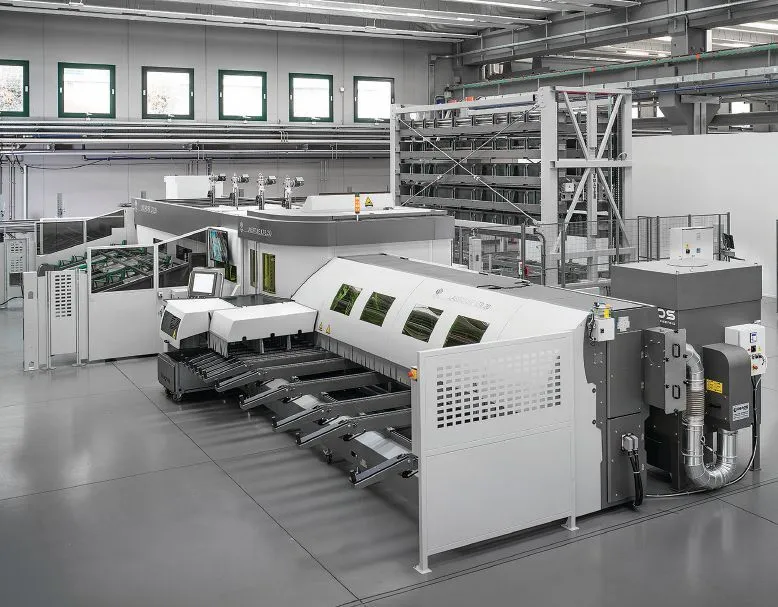
A BLM Group LT8.20 fiber laser is paired with an automated tower storage system, which feeds tube material directly to the machine and returns unused stock without operator involvement.
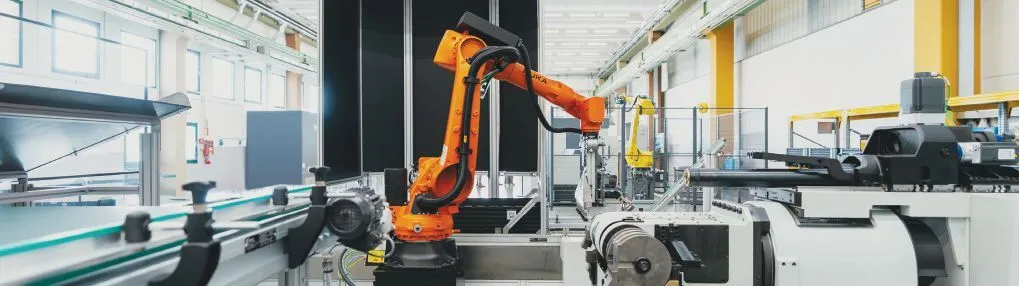
A robotic arm manages tube handling on the production line, reducing manual material handling and improving operator safety.
FIBER LASER FEATURES
The LT8.20 fiber laser is best suited for full load/unload automation. The laser features a fully automatic bundle loader to accommodate square, rectangle and round material. The LT8.20 integrates pushers to keep tubes loading without human intervention. Tubes are automatically kept in their sorted shape during loading and for unloading.
A configurable, double-sided loading system on the LT8.20 allows operators to easily manage normal production as well as hot jobs. Multiple unloading destinations on the LT8.20 gives the machine more time to run without requiring an operator to clear the basket areas.
The LT8.20 features 5-axis cutting capabilities with a 45-degree tilting head. The machine can manage material up to 27 pounds per foot and diameters from 0.5 inch to 9.45 inches.
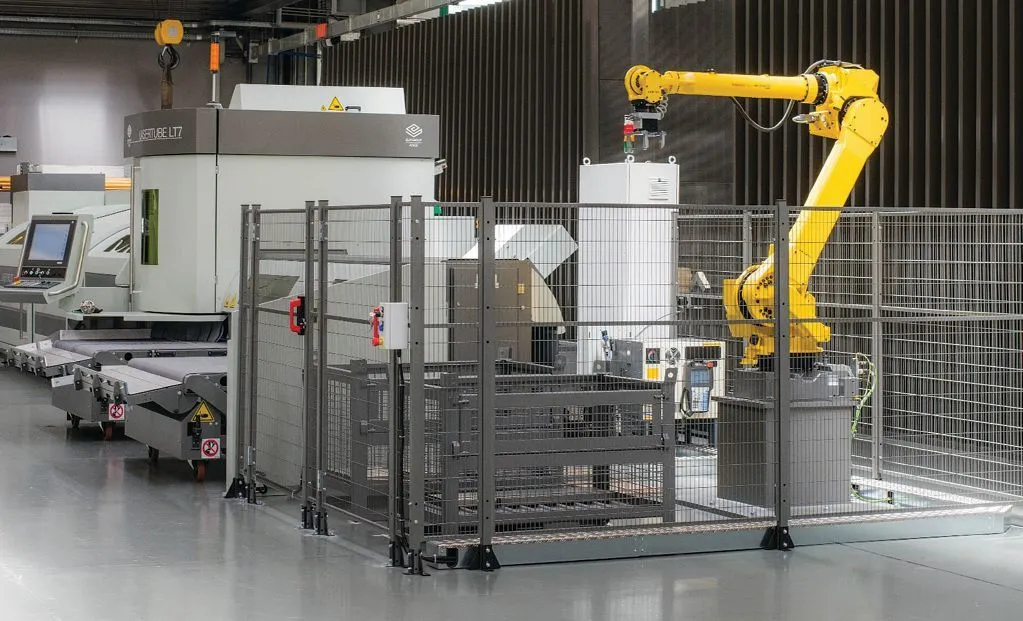
A robotic unload cell paired with a BLM Group LT7 tube laser automatically removes and organizes finished parts, keeping the laser cutting instead of waiting.
WAREHOUSE MANAGEMENT
For some customers, automating the warehouse may be their first step toward a lightsout operation. “Especially for businesses handling long products, automating the warehouse is logical. Handling 20- or 40-foot long material is not always easy. And these long products can take up valuable space on the shop floor,” says Gossard.
He points to vertical bins that lift long products off the shop floor and integrate with BLM Group laser and bending machinery. “It’s always the bundle at the bottom of a pile that has the tube needed next. The automatic tower magazines integrated into the tube laser make it easy to streamline the process.”
Carsten tells of the driving force behind a customer with a significant BLM Group automation system. The customer claimed that BLM Group’s inventory control has had the most impact on their operations. “When they would use a few sticks out of a bundle, the action wasn’t always recorded in inventory. A system solution was designed that uses a scale to weigh the cassette when it leaves the warehouse and again upon return, to accurately capture the change in available material,” Carsten notes.
Automation also reduces the risk related to material handling for customers, says Criger. “Moving a large, long load of bundled tube with a forklift can present safety concerns. The automated loading and unloading functions remove these factors,” Criger states, noting the ergonomic benefits to employees when operators are no longer repeatedly lifting heavy metal material and parts.
LESS MANPOWER
Automation that incorporates loading and unloading can help service centers and fabricators better utilize available manpower. Gossard shares the experience of one BLM Group customer in a remote area of western Canada. “They have difficulty recruiting equipment operators. With automation, they set up their tube laser to cut a single part overnight. They push a button at the end of the day shift and return in the morning to a bin full of processed tube,” he says.
The company has anticipated and integrated lights-out manufacturing features into its standard products. But not every job is a candidate for automation. Low volume, high mix applications can be more of a challenge.
“In reality, not every part can be processed in a lights-out factory.” Some jobs are better worked “when a human operator is observing the complexity of the parts,” explains Gossard.
Nor is every automated process intended to replace the human factor. “We consider automation a means of supplementing a shortage in labor, not replacing it,” reports Criger.
SUPPORT
Regardless of the level of automation, BLM Group has a standard training package for tube lasers that includes one week of onsite training at a BLM Group facility, one week at the customer’s facility during installation and a subsequent follow-up at the customer location a few weeks after installation. There is also a support team available to customers 24/7. “Our goal is to provide world-class manufacturing processing solutions for our customers, whether they operate in the dark or the light of day,” Gossard says.
BLM Group USA, 248/560-0080, blmgroup.com.