



Written by: Ferzam Berki
September, 2026- Interest in AI across the metals industry has evolved from healthy skepticism to serious evaluation. What service centers are looking for varies depending on the operation, but two pressures show up across the board.
The first is margin pressure. With rising prices and increasing mill lead times, service centers are looking for tools that help them get more out of every piece of inventory.
The second is an aging workforce. Retirements are projected to create a shortage of 15.6 million workers by 2030. For a service center, that gap is not just head count. The deeper loss is the veteran walking out the door with knowledge and judgement that took decades to accumulate.
There are a flood of AI tools aimed at the industry, and they’re being pitched at every level of the operation, from the front office to the shop floor.
FRONT OFFICE
In the front office, most of the AI tools are built to bring in more business. A handful of metals-specific customer relationship management systems have launched recently, built around how service centers actually sell. They handle prospecting and outreach and flag which accounts are due to reorder or are drifting away. The goal is straightforward: more quotes out the door and fewer customers slipping through the cracks.
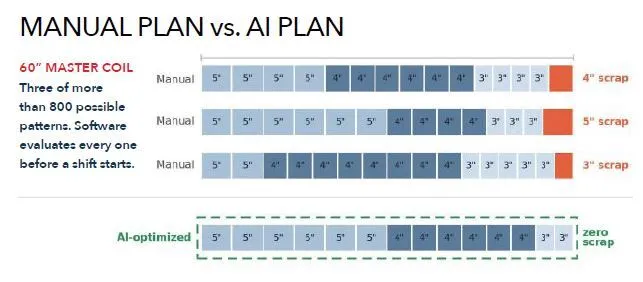
MANUAL PLAN vs. AI PLAN
PRODUCTION PLANNING
Deciding which inventory to use, how to process it and what to do with the drop has always been one of the hardest jobs—solved in spreadsheets or on pen and paper.
That traditional process leaves millions of dollars of metal in the scrap bin instead of on trucks headed to customers. Take a single coil. A 60-inch master with orders for 3-, 4-, and 5-inch strips can be slit more than 800 ways. Now do it with a full inventory of coils against a full book of orders, and creating optimal production plans becomes nearly impossible.
A new class of AI-native software takes a service center’s open orders and available inventory and builds optimal production plans instantly, within each customer’s specs and each line’s capabilities. The result hits the bottom line directly because better material utilization means more sellable product and less metal in the scrap bin.
From there, the same engine feeds better decisions on what material to buy and how to quote customer orders more accurately.
ON THE FLOOR
Shop floor tools move from reactive to predictive. Predictive maintenance watches equipment for the early signs of failure, so a line goes down on a planned Saturday instead of an unplanned Tuesday. Real-time quality control uses vision systems to classify surface defects as material runs, catching a problem before it ships and comes back as a claim.
WHERE AI FALLS SHORT
Most of what’s being sold right now falls into one of two categories. The first is software built for another industry and adapted for metals. Be wary of this option. When a tool was built by people who aren’t from this industry, the constraints that define your operation get treated as edge cases to configure around instead of the core of the job.
The second is a thin wrapper on a language model, with no real engine underneath. Anyone can open ChatGPT and have it summarize a report. But the tools worth paying for have proprietary technology under the chat window, built on algorithms with a deep understanding of service centers. If a vendor can’t point to what that is, it’s probably not there.
MAKING JOBS EASIER
The best tools in this industry get two things right. First, they make people better at their jobs instead of replacing them. When a 30-year veteran retires, that expertise doesn’t have to leave with them. The right tool captures it and hands it to the next person.
Second, the team actually wants to use it. Management can always find the value on paper, but if the people who will run it every day are the ones pushing to bring it in, that tells you more than any demo. It’s essential to get that buy-in before you commit.
Margins stay tight, mill lead times keep stretching and the expertise that used to absorb all of it is walking out the door. The service centers that come out ahead will be the ones that choose tools that speak the language of their operation—and are honest enough to walk away from the ones that don’t.
Ferzam Berki is co-founder and COO at LineSight (http://linesight-ai.com). After several years working in a service center, he now helps service centers cut scrap, protect margin and adopt automation that fits how their floors actually run.