



September, 2026- While steel supply is tight under the current tariff regime, some previous offshore manufacturing capacity is trickling back to the U.S. Some steel users are attempting material substitutions. Numerous customers are turning to Steel Warehouse at the early design phase for new parts and components so they can get the exact right product for the application.
If there are nuanced ways to manage supply chain volatility, if there are smart ways to manage customers’ expectations and mitigate risks, if there are productive ways to tackle new geographic markets, and if there are ways to create and maintain long-lasting relationships—Steel Warehouse’s team has years of experience navigating all of that.
Marc Lerman, chief commercial officer for the 18-location steel processor, talks about how the nearly 80-year-old company faces the myriad challenges of the second quarter of the 21st century.
LEAD TIMES
Steel Warehouse primarily operates in flat-rolled steel, with its largest concentration in hot-rolled products, while also processing coldrolled material.
“Mill lead times [as of mid-July] are about eight weeks. Cold-rolled and coated are at about nine weeks,” Lerman says. Timing depends on where the order falls in the mill’s schedule, “so it could be 10 weeks. We are in July and some mills closed their August order books.
“There is very little spot availability,” he adds. “You won’t be able to walk in out of the blue, expecting to order steel, because most mills won’t have any stock without a contract.”
These days, most service centers and mechanical tube manufacturers do hold mill supply contracts. For just about every flat-roll product, availability is limited and mills are constraining output. “If you have a contract for volume, there is a range. Many of the mills are holding that volume toward the low end. And they have been doing that for most of the year,” Lerman says.
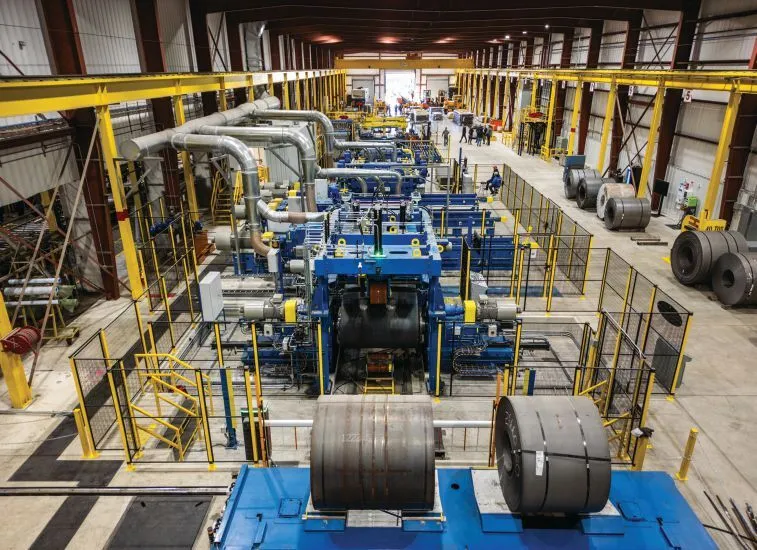
The new high-capacity hybrid leveling line at the South Bend facility combines automation with precision processing to produce consistent, high-quality flat-rolled steel.
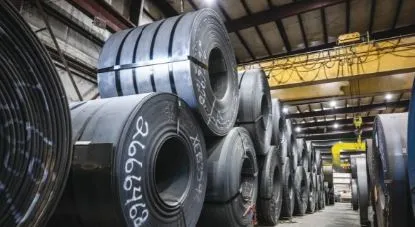
Steel Warehouse’s South Bend, Indiana, facility cuts steel to length and stocks “the right inventory at the right time” to help manufacturers navigate changing market conditions while ensuring reliable material availability.
COMPLICATIONS
Lerman says steel buyers must consider declining imports, greater reliance on domestic supply and changing trade policies across the U.S., Canada and Mexico. The movement of steel and semifinished products across borders has become increasingly complex.
These conditions have also created different price dynamics for U.S.-made-and-melted steel and for products made or processed in Canada and Mexico. “To ship into the U.S. is complicated; and for the U.S. to ship into Canada and Mexico is also complicated,” he says.
Steel buyers now have access to indexes, futures and other tools that can help them manage pricing risk, Lerman says. That has become increasingly important when “a $50- to $60-per-ton price change can happen inside of one week.”
RESHORING AND LABOR
Manufacturers doing business with the United States are asking whether reshoring is the right move. Companies considering a new U.S.
investment must weigh how long the current trade policies will remain in place, according to Lerman. “What is the trade policy that supports that, and for how long? It is a legitimate question. If you want to start a new project and invest in some part of the U.S., you must determine how long these tariffs will impact the market.”
Reshoring, in theory, should create good paying manufacturing jobs. Yet, “we have a history of struggling to find high-quality employees. That’s well documented. We still continue to see that as a challenge.”
Labor availability is therefore another factor manufacturers must consider when evaluating a reshoring project. Automation may help address staffing needs, but it also changes the employment equation. “Reshoring might actually exacerbate the talent shortage. You have to think through that,” Lerman says.
“We have seen some customers reshore.” Others decided against it.
Regarding near-shoring, Lerman says that Mexico and Canada have always been valuable trade partners, “especially in shipping semifinished products back and forth across the border. Are these policies going to stick? Will we make a deal?” The future of those arrangements will depend on how trade policy evolves, he says.
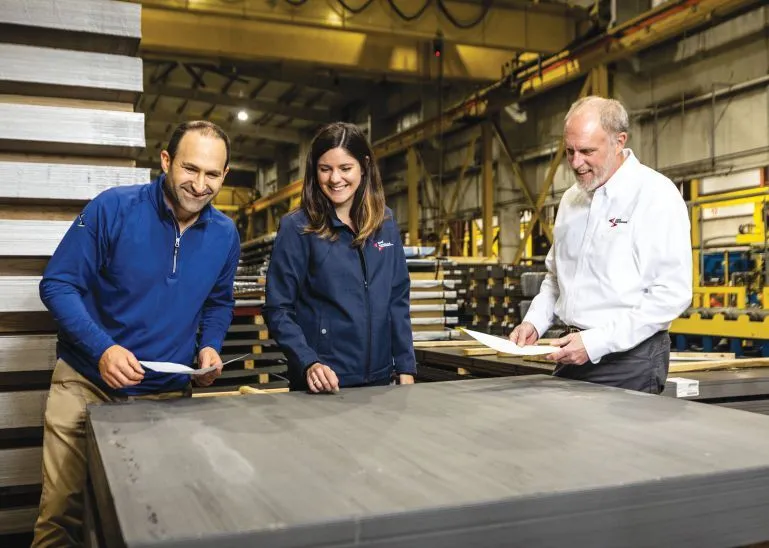
Steel Warehouse’s metallurgical experts Nicholas Kaufmann, Allison Lucak and Mick Gugel work with customers to verify material characteristics and recommend the best steel grades for each application.
EXPLORING MATERIAL OPTIONS
Due to the high tariffs on foreign steel products and tight or nonexistent supply from domestic sources for certain products, “customers are making substitutions,” reports Lerman. “A 50-percent increase in raw material price forces that.” Higher raw material costs are pushing more customers to evaluate alternatives, he says.
In some cases, comparable products are not available from domestic producers, so customers must continue buying from foreign sources. “They need only that and the product cannot be substituted. If you are getting a higher yield loss or there is a risk of product failure, you are not going to switch to another grade that is made domestically,” he says.
In other cases, customers have successfully substituted domestic products. “The big story is about access to steel overall,” Lerman notes. “The mills are rolling but if you are a service center or an OEM, you need a contract. Most mills don’t have the capacity to take on more orders.”
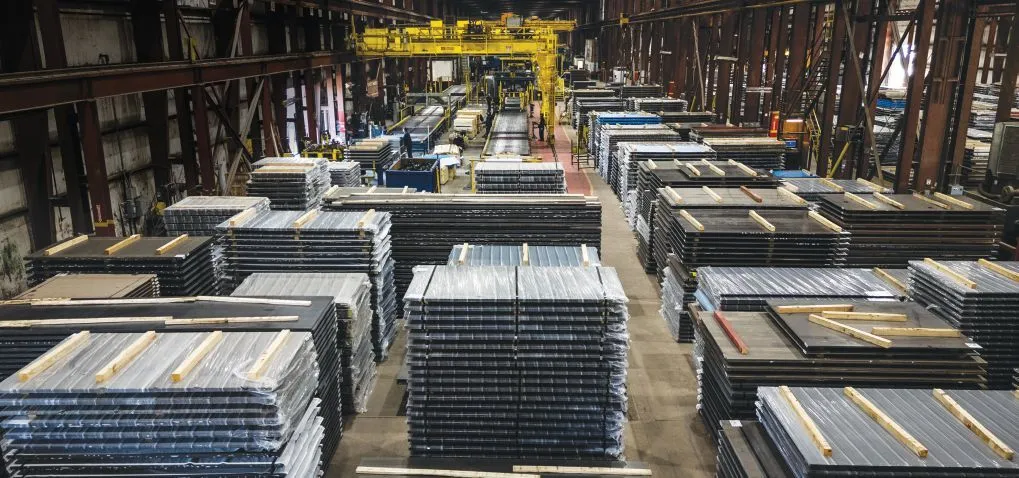
Finished steel plate is staged for shipment. Efficient material management supports reliable customer deliveries.
HYBRID LINE
Steel Warehouse installed a new hybrid leveling line in South Bend, Indiana, last autumn and spent several months bringing it online. “We had a line that was maybe 25 years old. It was behind on technology,” says Lerman. “It was less productive. Although it could deliver good quality, we had to skin pass coil to coil. It wasn’t efficient.”
The new line, which manages steel up to 3/8 inch thick, is highly automated and “is expected to surpass previous quality levels while increasing productivity,” he says. Annual capacity for the CTL line is between 150,000 and 200,000 tons.
The company opened two locations in recent months: Jefferson City, Tennessee, and Hickory, North Carolina. “The main reason for most of our investments is customer driven.” The new Tennessee service center performs laser cutting. “We are profiling parts for several customers,” Lerman says.
The North Carolina branch wa also driven by a customer relationship and additional demand for Steel Warehouse’s processing capabilities. Lerman says it will be operational at the beginning of the fourth quarter. The site offers cut to length and laser cutting services.
SUPPLIER RELATIONS
“Our main strategy is to take care of customers and follow them where they go, and that has proved successful for us.” Lerman acknowledges that “you cannot make everyone happy. But we do what we can to take care of customers.”
The company is carrying less inventory than in the past, but it’s “the right inventory at the right time,” he says. “We work with our suppliers very closely; we have longstanding supply relationships. That is key. We stay with them through good times and bad. You will be better off with those relationships. “We are in business to add value to the supplier as well as to the customer,” Lerman explains.
EXTRA ASSISTANCE
One of the services offered by Steel Warehouse is consulting with customers about material selection.
“We put a lot of emphasis on understanding our customers’ applications. We look beyond the material itself and ask why it’s being used for a particular part. In many cases, we’ve helped customers redesign their parts or manufacturing processes to improve efficiency and reduce costs. ” Lerman says, adding, “That’s a tremendous value for our customers.”
That support can include troubleshooting a part that is not forming correctly, evaluating lightweighting opportunities, considering tubing instead of sheet or plate, or identifying a material with higher strength or greater formability.
“Our metallurgists and engineers evaluate parts for customers across a wide range of industries,” Lerman says. “We enjoy having those conversations because they give us the opportunity to solve problems. We also host webinars to share that expertise and help customers find better ways to manufacture their parts.”
“We enjoy helping customers improve their designs whenever it makes sense,” Lerman continues. “The world has gotten smaller, and our core mission is to solve problems, whether they’re related to logistics, tariffs, material selection, or part design.”
Steel Warehouse Co., 800/348-2529, steelwarehouse.com
.