





With gas storage and export projects in various stages of approvals, it’s tempting to put pedal to the metal
With gas storage and export projects in various stages of approvals, it’s tempting to put pedal to the metal
November 2018 - A typical multimillion-gallon storage tank for liquefied natural gas contains an inner liner, outer shell and roofing system made with steel carbon plate and corrosion resistant stainless steel plate; not to mention the foundation containing rebar; the tubing, piping and valves leading to and from the tank; the ladders and other external features.
Because many of the LNG export terminals that will be built over the next few decades are in hurricane zones (Gulf Coast) or within the “ring of fire” (Pacific Northwest), they will need structural systems around them that can withstand storms and seismic activity. Don’t forget the port infrastructure and the tanker ships that will be built to meet increasing global demand.
Despite much digging, we’ve found it impossible to estimate the volume of ferrous and nonferrous metals that might be consumed in a “typical” LNG storage facility or export terminal. For one thing, the designs become larger with each iteration. But suffice to say that it’s many thousands of tons.

Between inner liners, outer shells, pipe and tubing, valves and ladders, roofing and structural elements, a liquefied natural gas complex consumes thousands of tons of fabricated metals.
Noting that the United States has transitioned to being a net exporter of natural gas, the Energy Information Administration expects U.S. gross exports of natural gas to rise 16 percent this year versus 2017—with most of the growth in exports of liquefied natural gas. Up north, more than 30 LNG export projects have been proposed, primarily in western Canada. To date, Canada’s National Energy Board has authorized 18 LNG export projects—13 in British Columbia and five in Nova Scotia and Quebec.
The International Energy Agency (IEA), meanwhile, issued an analysis of global demand and the movement of supply. “In the next five years, global gas markets are being reshaped by three major structural shifts,” said Executive Director Fatih Birol. “China is set to become the world’s largest gas importer within two to three years, U.S. production and exports will rise dramatically and industry is replacing power generation as the leading growth sector.”
Chinese gas demand is forecast to grow by 60 percent between 2017 and 2023, underpinned by policies aimed at reducing air pollution by switching from coal to gas. China will be the largest natural gas importer next year.
On the supply side, the U.S. is leading gas production growth worldwide to 2023, thanks to shale extraction. “Most new U.S. supplies will be geared to export markets as LNG or through pipelines,” IEA’s report states. “LNG trade as a share of total [global] gas trade is forecast to rise from a third in 2017 to almost 40 percent in 2023. The current wave of LNG export projects will increase liquefaction capacity by 30 percent” within the same period.
The latest project approved is LNG Canada, financed by a consortium of international players, The export terminal will be built in Kitimat, British Columbia. Justin Trudeau, prime minister of Canada, said Oct. 1 that the deal “represents the single largest private sector investment project in Canadian history.”
TransCanada Corp. will build, own and operate the 670-kilometer Coastal GasLink (CGL) pipeline that will connect natural gas from northeastern British Columbia to the export plant in Kitimat.

APPROVED TERMINALS as of July 2, 2018 // 1-4 are import terminals: Corpus Christi LNG/Cheniere; Aguirre Offshore GasPort LLC, Salina, Puerto Rico; Gulf of Mexico: Main Pass McMoRan and TORP Technology-Bienville LNG. Export terminals: 5. Hackberry, Louisiana, Sempra-Cameron LNG. 6. Freeport, Texas, Freeport LNG expansion. 7. Cheniere-Corpus Christi LNG. 8. Sabine Pass, Louisiana, Sabine Pass Liquefaction. 9. Elba Island, Georgia, Southern LNG Co. 10-11. Lake Charles, Louisiana, Southern Union-Lake Charles LNG and Magnolia LNG. 12. Sabine Pass, Texas, ExxonMobil-Golden Pass. Canada 1-4: Port Hawkesbury, Nova Scotia, Bear Head LNG; Kitimat, British Columbia, LNG Canada; Squamish, British Columbia, Woodfibre LNG Ltd.; and Prince Rupert Island, British Columbia, Pacific Northwest LNG.
More to come
Let’s take a look at other North American projects in various stages of environmental review, permitting and other regulatory milestones.
The Federal Energy Regulatory Commission (FERC) set Jan. 31, 2019 as the planned completion date of the final environmental impact statement for siting, construction and operation of a proposed Port Arthur LNG natural gas liquefaction-export project in Jefferson County, Texas, according to San Diego-based Sempra Energy.
“Sempra Energy’s new liquefaction facility will be a boon to the Port Arthur community and to the entire state of Texas,” said Gov. Greg Abbott.
“Southeast Texas is America’s energy gateway,” said U.S. Rep. Randy Weber. “As more LNG facilities come online, the contributions our region makes to America’s energy dominance further increase.”
The Port Arthur project is expected to include two natural gas liquefaction trains to enable the long-term sale of 11 million metric tons of LNG per year; feed gas pre-treatment facilities; natural gas liquids and refrigerant storage; up to three LNG storage tanks; two marine berths and associated facilities.
Connections
Williams Cos., Tulsa, Oklahoma, expects to launch service during first-half 2019 on its Gulf Connector Expansion Project. It is a 475,000 dekatherm-per-day expansion of the Transco pipeline system in Texas and Louisiana to connect U.S. natural gas supplies with LNG markets across the world.
Constructed in two phases, Gulf Connector will deliver natural gas to feed two LNG export terminals in Texas—one on the northern coast of Corpus Christi Bay, and another at Freeport Bay. The project includes three compressor stations; piping and valve modifications on Transco’s mainline; and the addition of one new interconnect with Corpus Christi LNG.

Back in May, Cheniere Energy Inc. made a positive Final Investment Decision (FID) with respect to Train 3 at its Corpus Christi liquefaction project and asked its primary contractor to move forward with construction. “We continue to see significant tailwinds in the global LNG,” said Jack Fusco, Cheniere’s president and CEO.
FERC notified Annova LNG that it will schedule an environmental review for its $3 billion, 6.0 mpta LNG export facility in Brownsville; and notified Texas LNG of the same decision. Annova LNG expects the final Environmental Impact Statement from FERC during second quarter 2019, followed by final FERC authorization during third quarter 2019 and an FID during fourth quarter. Commercial operations would begin in 2024. Texas LNG seeks to build a two-train, 4 million mtpa plant at the Port of Brownsville.
East Coast
Commercial operations began in April 2018 at the Dominion Energy Cove Point LNG Liquefaction plant in Lusby, Maryland. Ships are delivering American gas to Japan and India. Construction began in October 2014. Costing roughly $4.1 billion, the liquefaction facility has a nameplate capacity of 5.25 million tons per year of LNG.
Up in Nova Scotia, Pieridae Energy has planned the Goldboro LNG project, which will include a natural gas liquefaction plant and facilities for the storage and export of LNG, including a marine jetty for loading. The facility is anticipated to produce 10 million metric tons of LNG a year and have on-site storage capacity of 690,000 cubic meters.
The facility, which will cost at least $5 billion, is adjacent to the Maritimes & Northeast Pipeline, a 1,400-km transmission pipeline transporting natural gas between developments in Nova Scotia, Atlantic Canada, and the northeastern United States. Commercial operations are expected to begin 2023 pending regulatory approvals by federal and provincial authorities.
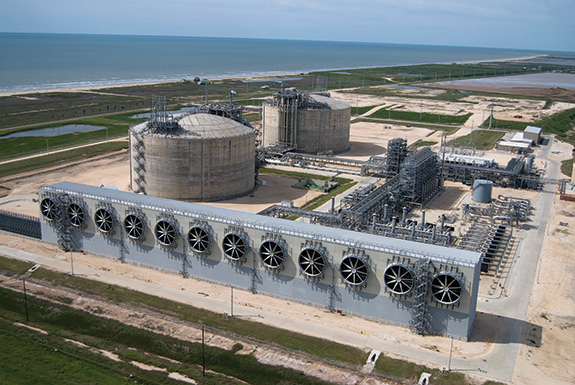
When completed in 2019, Freeport LNG’s three-train facility will produce and export 15 mtpa of LNG in Freeport, Texas.
But … pace yourselves
Evraz NA President and CEO Conrad Winkler recognizes opportunity with the oil and gas capacity buildup that’s going on throughout North America.
“Clearly, when these terminals get built, it’s all steel,” Winkler said during the CRU North American Steel Conference in early October. “So from our perspective, without the current tariff regime, that would be exciting for us to serve out of Portland (Oregon) and Regina (Saskatchewan). Vancouver is pretty remote from everyone except for Evraz North America.
“I don’t remember the amount but it’s a huge tonnage [of steel] for an individual terminal. In addition, the fabrication of those terminals represents a huge economic boost in the area. Building those terminals will be great if you have enough skilled people. Certainly the building of those terminals is exciting both in western Canada and Texas,” Winkler said.
Paul Vivian, principal of Preston Publishing Co., which produces the Preston Pipe & Tube Report and Preston Well Completion Report, warns that these projects take time to become operational and that, frequently, the raw material was purchased long ago and sits on the ground for years before being installed.
In the U.S., he says, “There are five more permits up for approval right now. There were about seven originally, then that grew to 10 projects. Three are approved. It just takes a long time. The price factors are really high risk and facilities go forward at a slow rate of speed.
“[Steel] won’t be an industry saved by this in the short term,” Vivian noted. “Like Conrad said, you have to take a massive amount of tubes and divide it up by four or five years. Unless there are a couple of projects going on at the same time, it has minimal impact on supply.” MM