





Straddle carriers are customized to fit tight spaces while moving long, heavy loads efficiently and safely
Above: Straddle carriers are customized to match particular needs, including lift capacity, length of loads or the ability to enter narrow spaces.
Straddle carriers are customized to fit tight spaces while moving long, heavy loads efficiently and safely
May 2018 - A 20-year-old mobile machinery builder based in Monaghan, Ireland, has driven a clear path into the North American market by helping customers manage their awkward, cumbersome and time-consuming material handling problems differently.
The Combi-SC straddle carrier is one of 20 distinct material handling solutions offered by Combilift USA. These include multidirectional lift trucks, narrow-aisle trucks, articulated trucks, low-profile lifts and mobile gantries.
“We are experts in making a customer’s space work harder, which typically consists of enhancing safety, increasing storage and maximizing efficiencies,” says Anthony Rooney, Combilift sales director for the United States, United Kingdom and Ireland.
Paul Short, president-North America, explains the safety component of the straddle carrier. “The traditional way to load a trailer is someone needs to be up there and build the load on the trailer deck.” But there is a risk of being struck by material and even of being knocked off the trailer. “We remove working at height. If you can build the load at ground level, and pick the entire load up and place it on the trailer, that is safer.”
Rooney says Combilift’s desire to deliver innovation has led to the range of multi-directional forklifts and sideloaders it offers today. These machines help address customers’ material handling challenges, particularly for long, heavy loads like beams, pipe and tube, bar and rod. A standard beam length is 40 feet, and these often have to be accessed from storage racks that are perhaps 10 feet wide or narrower.

“Fabrication shops, for example, want to weld beams, take them to end of the shop and store them until they need to be shipped to site. We found they were fabricating, taking beams to the end of the line, using a forklift to move them out into the yard and then storing the beams on trailers, paying additional costs if there were any delays inside the building.
“With our machine, we pick the product up from the fab or preparation area, and perform only one lift onto the trailer heading to the job site,” Rooney says.
Using a Combilift straddle carrier, “on labor alone you can pay off the machine in 14 months,” Short says, or even more quickly “when you consider trailer rental costs.”
Gearoid Hogan, a regional representative for Combilift, notes that the straddle carrier is also sold to service centers “managing coils. Instead of using forklifts and wide aisles, we can store coils three to four wide and three to four high.”
Productivity impact
A common problem for steel processors and fabricators is the movement of material directly over work areas. For example, says Rooney, to remove a beam from outside storage and to the welding area inside a shop, the shop typically uses an overhead crane. But that load is hovering above the welding cells and welders have to stop working while the crane is moving. They’ll also wait for the crane to deliver material for the next job.
“So there’s a lot of downtime,” Rooney says, but with a straddle carrier or a multi-directional forklift from Combilift, “a shop can now drive the truck down an alleyway and not interrupt the work.”
Short cites one customer that, due to those interruptions, was compelled to hire extra welders to finish jobs on time. After purchasing the carrier, the company experienced a 20 percent gain in productivity, he says.
In many service centers and fab shops, there are multiple drop-off points for material, meaning loads are touched multiple times. “They would have multiple trucks each performing one function and multiple operators to do multiple functions. We have one truck, and one operator, to do all that,” says Rooney.
Short enumerates “the time savings, labor savings and supervisory time. You can take those extra truck operators and have them doing some value-added work” like drilling holes, instead of material handling. “Companies are not making money moving material, they make money when the material is delivered.”
Location, location, location
“You can telescope the carrier, meaning you are able to change height to go inside, and then raise the height when the machine is in the yard,” says Short. That’s particularly important when stacking material outdoors, building loads on the ground and then moving them to trucks for shipping.
Rooney notes that straddle carriers can replace cranes inside service centers and fab shops.
“Overhead cranes must be on rails. A crane picks up a load and brings it in a straight line to another area. So a crane just moves back and forth. A straddle carrier can go anywhere in your yard and building. It travels anywhere a car can go.”
Many products—painted beams or coated coils, for example—are surface sensitive. “For a customer painting beams, no fork ever touches that product,” so the paint won’t be marred or chipped, says Rooney.
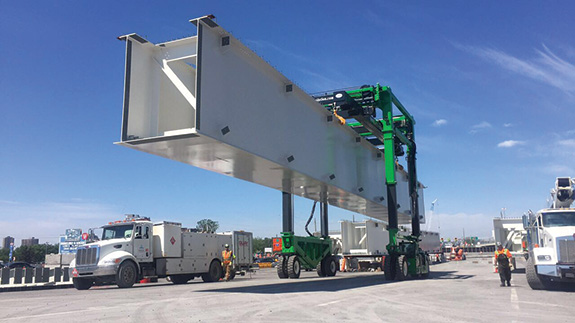
For those supplying infrastructure projects or bridge builders, the product is getting longer and heavier—the challenge is greater.
Consulting
Combilift does more than build trucks. It is a full-service consultant, according to Short. “We have engineers that work on warehouse optimization and yard layouts, designing logistics flows through facilities. It’s a free service to help customers maximize storage.” Combilift has 20 regional product managers across North America who are trained in design, Rooney says.
“Our process is very consultative in nature,” says Hogan. “We see ourselves as personal trainers for the material handling world—designing the environment around the equipment. We help them understand that to get it to work, they might have to change the way they do things.”
Size and scale
Rooney says many service center operators have already converted to Combilift sideloaders, including Ryerson Inc., Russel Metals, Reliance Steel and Aluminum Co., A.M. Castle & Co. and Yarde Metals.
“From the big names to the small fabricator, those serving infrastructure such as Schulte Building Systems Inc. to bridge builders like Casco Bay Steel Structures Inc., we find the product is getting longer and heavier and the challenge is greater.”
Combilift builds a range of units between 1,800 and 200,000 pounds of lifting capacity.
“One of our strengths is customization.” Short says. “Say you have 17,000-pound capacity requirement, but you need an extra long deck, or an extra long fork or a special mast. That is part of our value add. We listen to customers and then turn to our engineers.”
In terms of scale, using a Combilift truck, a service center can rearrange storage racks to be longer, taller or closer together, creating more density of inventory, while opening up floor space for value-added work. “This brings down the cost per square foot,” says Rooney.
Growth trajectory
Combilift has nearly 40,000 trucks in operation around the world, all built since 1998, says Rooney, adding that the first machine it ever built is still in service. “Each one of those trucks is providing efficiencies and cost reductions,” according to Rooney.
The company just finished construction on a 500,000-square-foot factory. The grand opening takes place in May. With the new plant, Combilift expects to double its current production in the next 12 months, “based on orders in hand and projected orders.”
Combilift employs 550 people, supported by a global dealer network that includes 105 sales and service dealers in North America, plus parts distribution out of Greensboro, North Carolina.
“We are experiencing huge growth and that will continue into the next stage, especially in North America. We expect to expand our product portfolio,” Rooney says. MM